
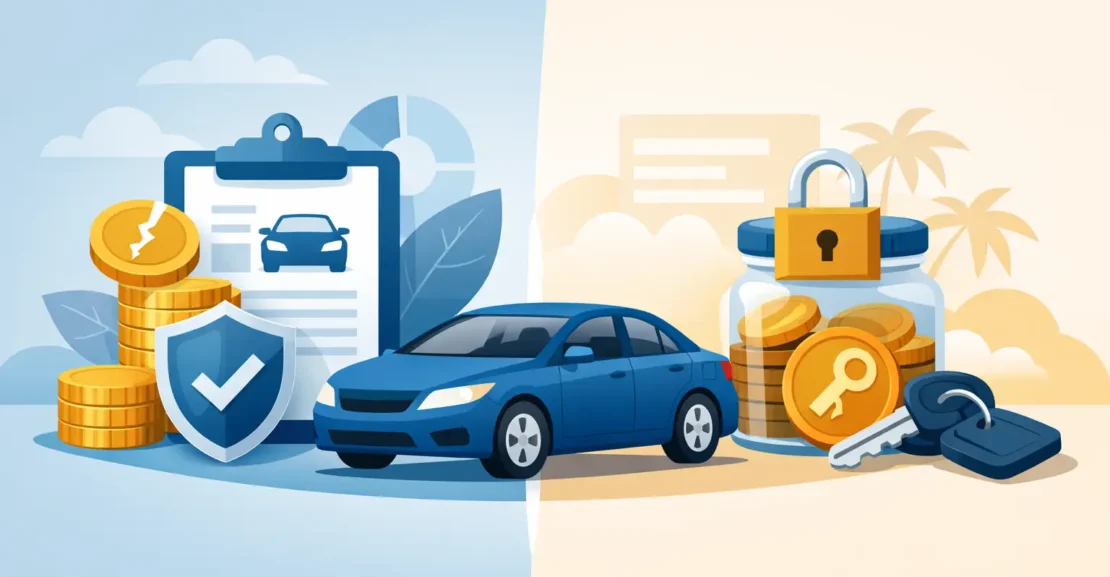
You have landed at Tirana International Airport, collected your bags, and are ready to start driving. At the rental desk, two terms can cause unnecessary confusion: rental excess versus deposit. They are connected, but they are not the same charge. Knowing the difference helps you choose coverage confidently, prepare the right payment card, and avoid surprises when you pick up your car.
A deposit is usually a temporary amount held on your card. An excess is the maximum amount you may be responsible for if the rental car is damaged, stolen, or affected by another covered incident. The amount shown on your booking or rental agreement is the one that matters, so always review it before confirming your reservation.
Rental Excess Versus Deposit: The Simple Difference
Think of the deposit as a security hold and the excess as your financial responsibility under the rental terms.
When you collect a car, the rental company may place a pre-authorization hold on the main driver’s credit or debit card. This is the deposit. It is not necessarily money taken from your account as a completed payment, but it can reduce the available balance or credit limit on your card while the rental is active.
The excess applies if there is a valid claim for damage, theft, or another event covered by the rental agreement. For example, if your excess is $800 and qualifying damage costs $300 to repair, you may be charged up to $300. If the damage costs $1,500, your responsibility may be limited to the $800 excess, subject to the agreement and any exclusions.
The deposit is often set high enough to cover the excess, plus possible charges such as fuel differences, late returns, tolls, traffic fines, missing items, or cleaning where permitted by the rental terms. That is why the deposit amount and excess amount may be similar, but they do not always match.
What Happens to the Deposit?
At pickup, your card may be pre-authorized for the required deposit. You should make sure the card has enough available funds before arriving, even if you prepaid the rental price online. A prepaid reservation does not always remove the need for a security deposit.
After you return the car, the vehicle is checked according to the rental process. If there are no additional charges, the rental company releases the hold. Your bank or card issuer then determines how quickly the available balance is updated. This can take several business days and, in some cases, longer depending on the bank, card type, and country where the card was issued.
This timing is one reason to avoid relying on your last available credit limit for a rental. If you plan to use the same card for hotel expenses, meals, or family activities, leave room for the security hold. It is a small planning step that makes the rest of the trip easier.
A practical example
Imagine you rent a family-friendly automatic car for a week in Albania. Your rental agreement shows a $1,000 deposit and a $900 excess. At pickup, the company places a $1,000 hold on your card.
You return the vehicle on time, with the agreed fuel level and no new damage. The $1,000 hold is released after the return inspection. You did not pay the $900 excess because no claim was needed.
Now imagine there is new damage that falls within the rental conditions and costs $600 to repair. The rental company may use part of the deposit process to collect the $600. Your excess is not an automatic fee. It is a limit on what you could owe when a covered incident occurs.
How Insurance Changes Your Excess
Basic rental coverage commonly includes an excess. Optional protection may reduce that excess, sometimes to a lower amount or to zero for certain types of damage. The exact protection available depends on the vehicle, rental location, provider, and terms selected during booking.
Lowering the excess can be useful if you prefer a more predictable travel budget. It can also be reassuring when you are driving unfamiliar roads, traveling with children, or planning to cover long distances between Tirana, the coast, and mountain destinations.
However, extra protection is not automatically the best choice for every renter. It adds to the rental cost, so compare that cost with the excess you are comfortable accepting. A short airport-to-city rental may call for a different decision than a two-week family road trip across the country.
Also, reduced-excess coverage does not mean every situation is covered. Common exclusions can involve driving under the influence, unauthorized drivers, using the wrong fuel, interior damage, lost keys, or driving on roads not allowed under the agreement. Tires, wheels, glass, and the underbody may have separate rules. Read the coverage terms rather than relying only on the name of the protection package.
Check These Details Before You Book
The easiest time to understand your responsibility is before you arrive at the airport. During the reservation process, look for the stated deposit, the excess amount, accepted payment cards, and any age or driver requirements. If a detail is unclear, ask before travel rather than making assumptions at the counter.
Pay close attention to whether the card must be in the main driver’s name. A card in a travel companion’s name may not meet the pickup requirements if that person is not listed as the primary renter. International cards can also have daily limits or fraud-prevention settings that affect a pre-authorization, so notifying your bank before traveling may help.
At pickup, take a few minutes to inspect the car with the rental representative. Make sure existing marks are documented, including small scratches, wheel scuffs, and windshield chips. Take clear photos or a short video in good light, and keep the vehicle condition report until after the deposit has been released.
Before leaving, confirm the fuel policy, the return time, and what to do if you have an accident or mechanical issue. This is especially helpful after a long flight, when it is easy to miss a detail. Euro Car Albania aims to make the airport pickup process clear so you can spend less time sorting out paperwork and more time enjoying the journey with your family.
When You Could Be Charged After Return
A clean return inspection is ideal, but some charges may be processed after you leave if they cannot be confirmed immediately. Traffic fines, toll notices, parking penalties, and certain damage assessments may arrive later. The rental agreement should explain how these are handled and whether an administration fee may apply.
Fuel is another common source of confusion. If your agreement requires you to return the car with the same fuel level, refuel close to the return location and keep the receipt. If the vehicle is returned with less fuel, the rental company may charge for the missing fuel and service costs according to its policy.
None of this means you should expect problems. Most rentals end with a straightforward return and release of the deposit. The point is to understand what the deposit secures and what the excess actually means before your trip begins.
Choose the Level of Risk That Suits Your Trip
There is no single right answer on excess protection. If you are comfortable accepting a higher potential cost in exchange for a lower rental rate, standard coverage may suit you. If you want to limit your exposure and keep your travel spending more predictable, a reduced-excess option may be worth considering.
For either choice, bring an eligible payment card, review the rental agreement, inspect the car at pickup, and return it as agreed. Once those details are handled, you can leave Tirana Airport with a clearer plan, a suitable car, and more attention for the roads, coastlines, and family moments ahead.